 Ocala Mobile Home Leveling
 Mobile Home Leveling & Releveling in Ocala, Florida
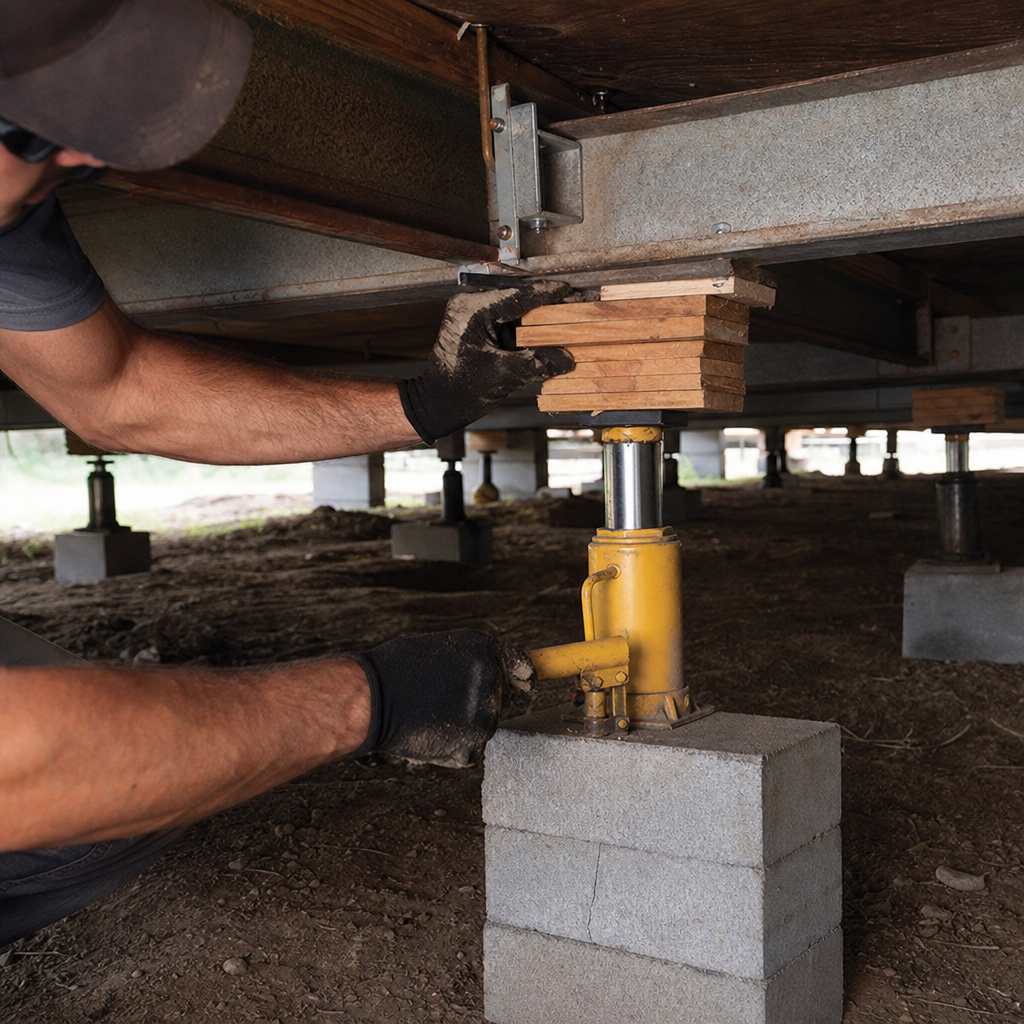
Releveling brings your home’s steel chassis back to a flat, evenly supported plane, and in Ocala it costs $450–$800 for a singlewide and $750–$1,400 for a doublewide, done in a single day by a local installer crew. If your doors stick, your floors slope, or your doublewide’s marriage line has opened a gap, this is the fix, and the level check that starts it is free.
Why this is the most-needed service in Marion County
Marion County’s manufactured homes sit, almost without exception, on stacked-block piers in deep Florida sand. The soils under the SR 200 corridor communities, the US 441 parks through Belleview and Summerfield, and the parks out toward Silver Springs are mostly Candler-type fine sands, a soil series literally first mapped in this county. They drain fast, hold little moisture, and compact under concentrated loads. Each pier presses several thousand pounds onto a couple square feet of that sand, and every June-through-September rainy season works fines out from under the footing pads.
So homes here settle. Not catastrophically, a quarter inch at one pier, a half inch at a corner where the downspout dumps. But a steel frame telegraphs every fraction of an inch into the structure above it, and that’s when you notice:
- Doors that stick, drag, or won’t latch. The frames have racked out of square
- Windows that bind in their tracks
- Floors that slope, dip, or feel bouncy underfoot
- Cracks opening at drywall joints, especially over doors and at ceiling corners
- Skirting buckling, bowing, or pulling away from the home
- On a doublewide: a gap opening along the marriage line, or the two halves’ floors no longer meeting flush
Any one of these means the frame has moved. Two or more means it’s moved enough to matter.
How the job is actually done
We publish the process because it’s how you can tell a real leveling crew from a guy with a bottle jack.
1. Map the frame with a water level. The crew pulls skirting access panels and crawls the full footprint. Every pier gets shot with a water level (or rotary laser) off a datum pier, usually the most stable one, often near the center. A water level reads true elevation by physics; there’s nothing to drift or miscalibrate. The result is a map: this pier is down 3/8”, this one 5/8”, these six are fine. While they’re under there, they also check every cap and shim for crushing and rot, and eyeball your anchor straps, settled homes always have slack straps.
2. Lift on cribbing, never on a bare jack. 20-ton hydraulic bottle jacks go on solid wood cribbing at the frame near each low pier. Then the frame comes up in small increments, moving jack to jack across the home. Nobody cranks one point until it’s high. That’s how amateurs crack drywall, pop trim, and stress plumbing. And nobody works under steel held only by hydraulics; the cribbing carries the load at every stage. That rule is non-negotiable and it’s how you know a crew has done this a thousand times.
3. Rebuild what’s low. At each dropped pier, the crew re-stacks or replaces blocks, swaps crushed or rotted caps and pads, and drives hardwood shims tight between cap and I-beam. HUD installation standards limit how tall a shim-and-lumber stack can be on top of a pier: a pier that needs a tall stack gets rebuilt instead, which is pier and pad repair at $150–$400 per pier, always quoted before it happens.
4. Verify everything. The whole frame gets re-shot with the water level, and every pier gets a load check. A pier you can rattle by hand is carrying nothing and will read as “level” right up until it isn’t. On doublewides, the crew confirms the marriage line has closed and both halves’ ridge and floors meet the way the manufacturer intended.
5. Re-tension the tie-downs and close up. Settling leaves anchor straps slack, and a slack strap does nothing in a hurricane. Re-tensioning to spec is part of the job, not an upsell. If the crew finds rusted, missing, or pre-1994-era anchors while under there, you’ll get an honest read and a separate number. See tie-downs and anchors. Same for tears in the underbelly, which settling commonly causes: vapor barrier replacement is its own line, never smuggled into the relevel price.
Timing and what to expect afterward
A singlewide takes 3–5 hours; a doublewide 6–8 because the marriage-line pier row roughly doubles the survey and shim work. You stay home. Utilities stay on. The satisfying part happens the same day: doors start latching again as their frames rack back square. Existing drywall cracks won’t heal, but they stop growing, and once patched they stay patched.
One honest caveat: on this county’s sand, releveling is periodic maintenance, like servicing a well pump. The 3–5 year interval is real. What stretches it is fixing causes: proper footing pads under rebuilt piers, gutters or downspout extensions that stop roof water from soaking a pier row, grading that doesn’t pond water under the home. The crew will point out any of those they see, because a customer who trusts us calls us back; one who feels hustled doesn’t.
Park home or private land, singlewide or doublewide: what changes
The physics never change, but the shape of the job does, so tell us which setup you have when you request the check.
Park and community homes (the majority of what gets leveled along SR 200, US 441, and SR 40) mean tighter lot spacing, park rules about skirting and work hours, and sometimes a park office that wants confirmation a licensed installer is on site. All of it is routine; these corridors are where the crews spend their weeks. Park resales are also where the pre-sale leveling inspection earns its keep, since most offices want a level-and-tie-down letter before approving a buyer.
Private-land homes on acreage, common around Dunnellon, Ocklawaha, and the county’s rural edges, bring their own variables: owner-era setups that were never quite to spec, attached carports and porch roofs whose separate supports have to be watched while the frame comes up, and well or septic lines that get located before jacks and cribbing go anywhere near them. None of that changes the price structure; it just gets surveyed and written into the quote instead of discovered mid-job.
Singlewide versus doublewide is the biggest cost and time lever. A singlewide rides two beam rows; a doublewide carries a third pier row down the marriage line that has to come back into plane with both halves matched, which roughly doubles the survey and shim work. That’s the whole reason the ranges differ. Triplewides and severely settled homes of any width get quoted after the free check rather than guessed at. Same licensing law, same flat published pricing, whatever category your home falls in.
Licensing: the part Florida is strict about
Florida law (§320.8249 F.S. and Rule 15C-1/15C-2) requires that installation work on a manufactured home, leveling, blocking, anchoring, be performed by a state-licensed mobile home installer. Marion County Building Safety requires that installer’s license number on installation permits. This isn’t bureaucratic trivia: it’s why you should never let a general handyman jack up your home, and it’s why you should ask for the installer’s license number, the paperwork that holds up with the county, your park office, and your insurer.
Get the free level check
Tell us your symptoms and your area, SR 200 corridor, Belleview, Summerfield, Silver Springs, Dunnellon, or anywhere else in Marion County, and a crew will shoot your frame, show you the readings, and hand you a flat written quote. The full price breakdown is already published on the pricing page, so you’ll know we’re not making up numbers on your driveway.
Frequently Asked Questions
What does releveling include for the price?
The full water-level survey of every pier, hydraulic lifting on proper cribbing, new hardwood shims at every low pier, a complete re-shoot of the frame to verify, and re-tensioning of your anchor straps. Singlewides run $450–$800, doublewides $750–$1,400. Piers that need rebuilding (not just reshimming) are quoted per pier before work starts.
Will jacking the home up damage it?
Not when it's done in increments. Damage happens when someone cranks one point far out of plane. That's what cracks drywall and pops trim. The crew lifts a little at a time, working across the frame, and on doublewides keeps the marriage line matched the whole way. It's slower and it's correct.
Do I need to move out during the work?
No. Almost everyone stays home. You'll hear some creaks as the frame comes back to plane (door frames squaring up, trim relaxing) and that's it. Water and power stay on.
My home was leveled a few years ago. Why does it need it again?
Because of what it sits on. Most of Marion County is deep, excessively drained fine sand that keeps compacting under concentrated pier loads, especially after wet summers. A relevel every 3–5 years is the honest norm here. Rebuilt piers on proper pads and better drainage stretch that interval.
How soon can someone come out?
Usually within the week, faster if a sale or an insurance deadline is driving it. Settling tends to show up in fall, right after the summer rainy season, so spring and winter checks book quickest.
Do you level homes on private land, or only in parks?
Both. Park homes along the SR 200, US 441, and SR 40 corridors are the bulk of the work, but private-lot homes on acreage, common around Dunnellon and the county's rural edges, are routine too. Acreage jobs just add a couple of survey items: add-on structures like carports whose supports have to be watched during the lift, and well or septic lines to locate before anything heavy moves. Pricing runs off the same flat published schedule either way.