 Ocala Mobile Home Leveling
 Pier & Pad Repair for Mobile Homes in Ocala
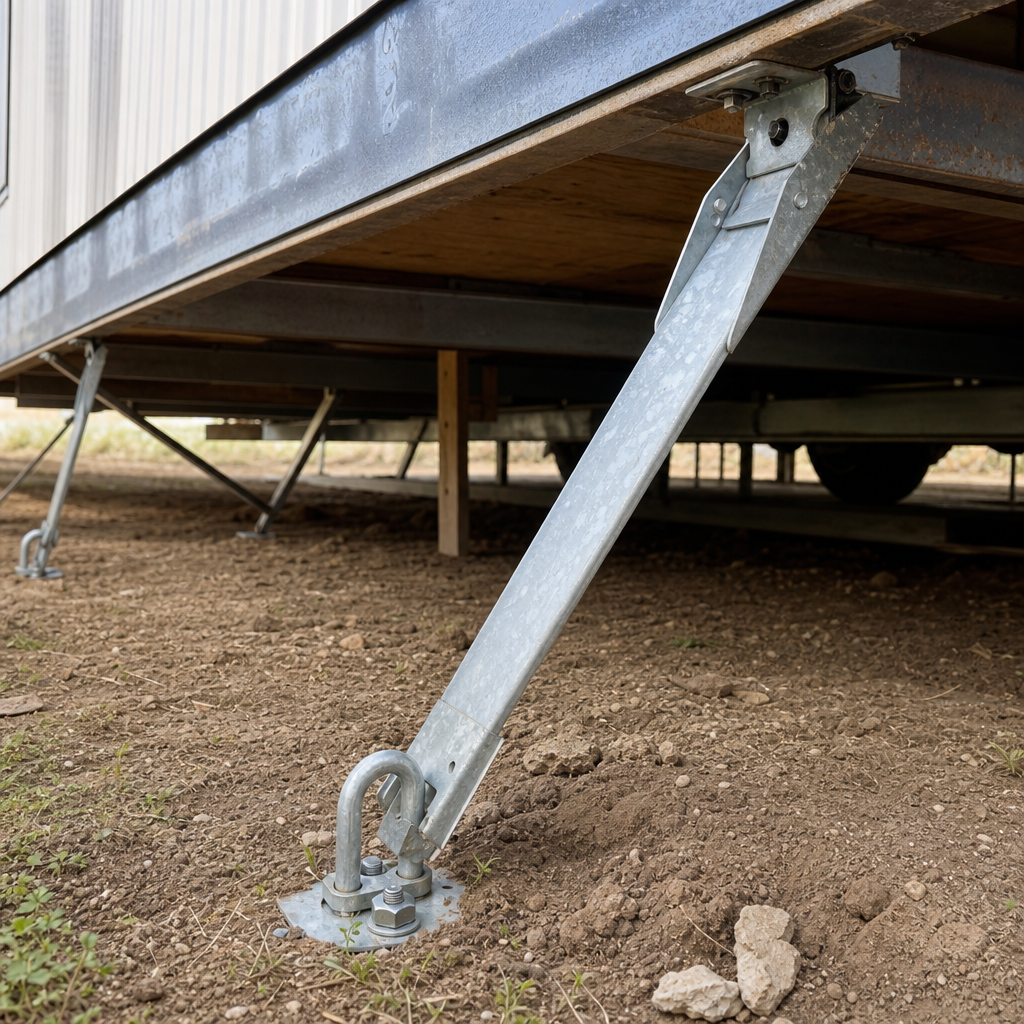
Pier and pad repair rebuilds the actual support system under your mobile home: the stacked concrete blocks, footing pads, caps, and shims that carry the frame. In Ocala it runs $75–$150 per pier to reset and reshim and $150–$400 per pier for a full rebuild, with most Marion County projects landing between $500 and $2,500. Every job is quoted per pier after a free under-home inspection, so you pay for the piers that failed and not one more.
What a pier actually is, and how it fails
Under your home’s steel I-beams sits a row of piers: a footing pad on the ground (concrete pad, ABS pad, or on old setups sometimes nothing but soil), stacked concrete blocks, a solid cap on top, and hardwood shims driven tight between cap and beam. Simple, proven, and every part of it has a failure mode, especially on this county’s ground:
- Pads sink or tilt. Marion County’s uplands are deep Candler-type fine sands: excessively drained, low cohesion, quick to compact under a concentrated load. A pier concentrates thousands of pounds on a couple square feet. Add a summer of daily thunderstorms moving water through that sand and pads settle, unevenly, which is worse than evenly.
- Pads were never adequate. Plenty of homes in the older parks along US 441 and out SR 40 toward Silver Springs were set decades ago on undersized pads, or blocks placed on bare ground. Those setups worked until the sand said otherwise.
- Blocks crack and shift. Decades of load cycling, plus the occasional tropical-storm shake (Irma, Ian, and Milton all pushed tropical-storm winds through Marion County), crack blocks and walk stacks out of plumb. A leaning pier carries load badly, then not at all.
- Caps crush and shims rot. Wood caps and shims are in a humid crawlspace inches off Florida ground. They crush under point load and rot where the vapor barrier is torn and ground moisture rises. A crushed cap can drop a beam a half inch on its own.
When any of this happens, the beam above that pier sags, neighboring piers pick up load they weren’t set for, and the failure spreads. That’s why one sticking door becomes three by the next summer.
How the work is done
Survey first. The crew crawls the full footprint and shoots every pier with a water level, mapping which ones have dropped and by how much, the same survey that anchors a full relevel. They also grade every pad, block stack, cap, and shim by condition. You get the map: these piers are sound, these need reshimming, these need rebuilds. No mystery, no “your whole foundation is shot” scare quote.
Lift safely. 20-ton hydraulic bottle jacks on solid wood cribbing take the beam load next to the failed pier. The load sits on cribbing, never on hydraulics alone, while the pier is open. The frame is lifted only as much as the rebuild needs, in small increments, so nothing above racks or cracks.
Rebuild correctly. Failed pads come out and proper footing pads go in, sized to spread the load on sand. Blocks are re-stacked plumb (or replaced), a sound cap goes on, and hardwood shims are driven tight, snug enough to carry full load, within the HUD stack-height limits. A pier that would need a tall shim stack gets built taller in block instead. That’s the standard, and it’s the difference between a repair and a patch.
Verify under load. The jacks come down, the pier takes its load, and the crew re-shoots the beam and rattles the pier by hand. A pier you can wiggle is decorative. Every rebuilt pier carries load or the crew isn’t done.
Why this matters beyond level floors
Piers are also what your tie-down system assumes is working. Anchor straps hold the home down; piers hold it up. A settled, half-loaded pier row lets the home move in wind that a solid setup would shrug off, and since Ian and Milton, Florida insurers have been asking hard questions about the condition of manufactured-home support and anchoring before they write or renew policies. If you’re selling, park offices and FHA/VA lenders around here routinely require a pre-sale leveling inspection that grades exactly these components. Rebuilt piers with proper pads are the strongest line item in that report.
Florida also has an opinion about who does this: §320.8249 F.S. and Rule 15C-1 require leveling and blocking work on a manufactured home to be performed by a state-licensed mobile home installer. Every crew we send carries that license and the insurance behind it, which is what makes the paperwork good with Marion County Building Safety, your park office, and your carrier.
What it costs, plainly
| Work | Price |
|---|---|
| Reset / reshim a pier (during a relevel) | $75–$150 per pier |
| Full pier rebuild: new blocks, cap, pad | $150–$400 per pier |
| Typical Marion County pier-and-pad project | $500–$2,500 all-in |
The wide project range is honest: a home needing four reshims after a wet summer is a few hundred dollars; an older US 441-corridor home whose original pads finally gave up might need ten rebuilds. The survey tells us which one you are, and the pricing page has every related number.
Start with the free inspection
If your floors slope, your doors stick, or your skirting is buckling, or you just haven’t had anyone under the home in years, get the free level check. A licensed local crew maps every pier, shows you the readings and photos of what’s under there, and quotes the fix per pier. That per-pier structure is what keeps this work affordable: four bad piers cost four piers’ worth of repair, never a lump-sum scare number. Serving Ocala, Belleview, Summerfield, Dunnellon, and all of Marion County.
Frequently Asked Questions
How much does pier repair cost in Ocala?
Resetting or reshimming a pier during a relevel runs $75–$150 per pier. A full rebuild (new blocks, cap, and footing pad) runs $150–$400 per pier. Typical pier-and-pad projects in Marion County land between $500 and $2,500 all-in, quoted per pier before any work starts.
How many piers does a mobile home have?
A singlewide typically rides on two beam rows with piers every 6–8 feet, often 12–20 piers. A doublewide adds a third row down the marriage line and can carry 24–40. That's why per-pier pricing matters: you pay for the piers that failed, not a flat 'foundation repair' number.
Why did my piers sink when the home was set up properly?
Marion County's upland soils are deep, excessively drained fine sands. The Candler series was first mapped here. Sand compacts under concentrated loads and summer rains migrate fines out from under footing pads. Even a textbook installation settles on this ground; that's soil behavior, not bad workmanship.
Can you just add more shims to a low pier?
Only up to a point. HUD installation standards limit how much shim and lumber stack is allowed between the pier cap and the beam. A pier that needs a tall stack is a pier whose pad or blocks have failed. It gets rebuilt. Anyone who fixes a badly dropped pier with a stack of lumber scraps is leaving you a worse problem.
Do you fix piers without doing a full relevel?
Yes, when the frame survey shows the rest of the home is still in plane, say one corner pier undermined by a downspout. But most homes with one failed pier have neighbors on the way, so the free level check covers the whole frame either way. You get the full picture, then decide.